

EHR Integration: What It Means and Why It Matters for Healthcare CRMs
Last updated: April 23, 2026
EHR integration is one of the most important technology decisions a healthcare organization can make because it determines whether patient data stays trapped in separate systems or moves cleanly across the workflows teams use every day. That matters at scale: as of 2021, 88% of U.S. office-based physicians had adopted an EHR, 78% had adopted a certified EHR, and 96% of non-federal acute care hospitals had adopted a certified EHR.
The reality is that an EHR by itself is only part of the picture. It may be the clinical source of truth, but it’s usually not the best place to run every part of the patient journey. Scheduling, intake, reminders, onboarding, follow-up, care coordination, and patient communications often need a different kind of system around the EHR to work well. That’s why the strongest healthcare tech stacks are not built around an EHR alone - they’re built around an EHR plus the right operational layer.
In this guide, we’ll break down:
- what EHR integration means
- the main components of an EHR
- how an EHR differs from a CRM
- why integration matters so much for healthcare CRMs
- and what should typically live in your EHR versus your CRM
What does EHR integration mean?
Quick Answer: EHR integration means connecting your electronic health record to other software so the right patient data can move between systems and support real workflows without constant manual effort.
If you’re trying to understand EHR systems meaning in plain English, start here: an EHR (Electronic Health Record) is your clinical record, and integration is what allows that record to work with the rest of your business. CMS describes the EHR as the electronic version of a patient’s medical history, including things like demographics, progress notes, medications, vital signs, immunizations, lab data, and radiology reports. Integration is what makes that information useful outside the chart itself.
In practical terms, EHR integration means your EHR can connect with tools for intake, scheduling, messaging, care coordination, reporting, billing workflows, or patient engagement. Instead of forcing staff to copy information from one platform into another, integrated systems let teams work from shared data. Health IT guidance frames this as reducing the “special effort” users need to exchange and use health information across systems.
That’s the real value. In addition to moving data around, good integration removes friction. Patients don’t have to repeat themselves, staff don’t have to chase down missing context, and operations teams can support care delivery without living in ten browser tabs at once.
What are the 5 main components of an EHR?
Quick Answer: The main components of an EHR usually include the patient chart, orders and prescriptions, clinical decision support, patient access tools, and interoperability capabilities.
There’s no official list that every vendor uses, but if someone asks what are the features of EHR software that matter most, five core areas come up again and again.
1. The patient chart
This is the heart of the system and includes demographics, notes and medical history, problem lists, medications, allergies, vitals, immunizations, lab data, and imaging results. It’s the core reason EHRs exist in the first place.
2. Order entry and prescribing
In addition to storing patient medical records, modern EHRs support computerized provider order entry, e-prescribing, and drug-drug and drug-allergy checks. These functions move care beyond static record storage and into active clinical workflow support.
3. Clinical decision support
This is where the EHR helps clinicians use information, not just document it. It pulls relevant alerts, rules, and evidence-based guidance at the point of care. CMS specifically notes that EHRs can support evidence-based decision support, quality management, and outcomes reporting.
4. Patient access and communication tools
Many EHRs include patient portal capabilities that let patients access records, review appointment information, and communicate securely with their care team. This has become increasingly important as digital access expectations have risen and telemedicine use expanded dramatically, with nearly 90% of office-based physicians reporting telemedicine use in 2021.That gives you a good sense of how standard these capabilities have become.
5. Interoperability
This is the piece that determines whether the EHR can actually work well with the rest of your healthcare tech stack, or if the EHR data remains isolated. Hospitals’ rates of “often sending patient information to outside providers” increased from 71% to 84% between 2018 and 2023, and “often receiving information” increased from 54% to 73%. That’s real progress, but it also shows why connectivity is still such a big topic.
Is an EHR the same as a CRM?
Quick Answer: No, an EHR is built to manage clinical records, while a CRM is built to manage patient communication, relationships, and operational workflows around care.
This is one of the most common points of confusion, especially for newer digital health companies. Both systems can hold patient information. Both can support workflows. Both can play a role in the patient journey.
But they are designed for different jobs:
- the EHR is centered on the medical record
- healthcare CRMs (like Tellescope) are centered on the relationship and operational experience around that record
That difference matters because a lot of modern care delivery happens outside the chart. Intake, onboarding, reminders, rescheduling, nurture campaigns, task routing, and care navigation all need structure and automation too. The AMA found that the average number of digital health tools used by physicians grew from 2.2 in 2016 to 3.8 in 2022, which tells you just how fragmented healthcare workflows can become when every need gets solved with a separate point solution.
So no, an EHR is not the same as a CRM. The better way to think about it is this: the EHR should hold the clinical record, while the CRM should help teams manage patient engagement and operations around care. When those systems are connected well, each one can do its job without forcing the other to do work it was never really built for.
Why is EHR integration so important for healthcare CRM solutions?
Quick Answer: EHR integration is what makes a healthcare CRM truly useful - it connects patient engagement and operational workflows back to the clinical record.
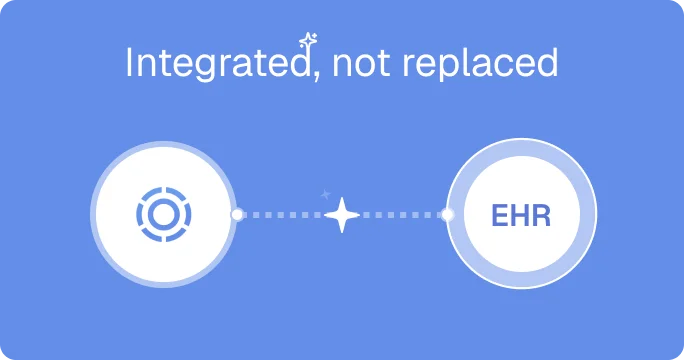
A healthcare CRM platform like Tellescope becomes much more valuable when it’s not operating in isolation. If the CRM can pull in the right patient context from the EHR and send useful information back where appropriate, teams save time, reduce errors, and get a more complete picture of what’s happening with each patient. If the systems are disconnected, people end up doing the same work twice.
That matters because the burden on clinicians and care teams is already high. The AMA reports that for every eight hours physicians are scheduled with patients, they spend more than five hours in the EHR. That’s a strong reminder that adding more disconnected software doesn’t automatically make work easier. In a lot of cases, it just creates more admin overhead.
Integration also matters because interoperability across healthcare is still improving, not finished. A recent ONC presentation shows that interoperability adoption has advanced significantly over time, but not every organization is operating at the same level yet (only 76%). For startups and clinics, a strong CRM-EHR connection can help close workflow gaps even when the broader environment isn’t perfect.
Patient expectations have also changed. Patients expect digital intake, reminders, online access, secure messaging, and a smoother experience overall. Many of those touchpoints live outside the core EHR, which is exactly why digital health organizations need a healthcare CRM layer that works hand-in-hand with it.
What are examples of EHR systems?
Quick Answer: Examples of EHR systems include athenahealth, Canvas, Elation, Healthie, Medplum, and DrChrono.
The right EHR depends a lot on what kind of organization you are. In the hospital market, the biggest names are easy to spot. Definitive Healthcare reports that Epic held 41.3% of U.S. hospital EHR market share in 2025, followed by Oracle Cerner at 21.8% and MEDITECH at 11.9%.
In ambulatory care, the field is broader. Definitive Healthcare’s 2025 ranking of ambulatory EHR vendors lists Epic first by installs, followed by eClinicalWorks, athenahealth, Oracle Cerner, and NextGen. That reflects how different the market can look once you move outside large inpatient systems.
For digital health startups and modern clinics, teams often evaluate more flexible EHR options too. That’s why at Tellescope, we believe in the importance of being EHR-agnostic and EHR interoperability because many startups aren’t just choosing an EHR based on charting needs. They’re also choosing based on how well it connects with the rest of their workflows.
Our open API capabilities allow healthcare orgs to integrate our healthcare CRM platform with whatever EHR best fits their needs. However, we do have native integrations with athenahealth, Canvas, Elation, Healthie, Medplum, and DrChrono.
What activities can be completed in an EHR or CRM system?
Quick Answer: EHRs are usually best for clinical documentation and medical data, while CRMs are usually best for patient outreach, intake, scheduling, and workflow coordination.
A simple way to think about the split is this: if the work is fundamentally clinical recordkeeping, it probably belongs in the EHR. If the work is about guiding the patient journey, communicating with patients, or coordinating operations, it often belongs in the CRM.
Some workflows can be done in either system - it just depends on your personal preference and the EHR/CRM capabilities.
When the Tellescope team works with customers to build their care workflows, we don’t try to sway our customers in a particular direction - we go with what’s the best fit for their needs. Because of that, an inevitable question we always get is some variation of “So what features live in [insert EHR name] and what lives in Tellescope?”
To help better illustrate this, we’ve put together an unbiased comparison that breaks down how most customers are using our platform with the EHR integrations we currently support:

athenahealth
athenahealth is a major ambulatory care platform that combines EHR, practice management, patient engagement, and revenue cycle capabilities within athenaOne. It’s especially well suited for outpatient practices that want a broad, mature platform with strong operational depth and network-driven workflows.
Best for: Ambulatory practices that want an established all-in-one clinical and operational platform with strong practice management depth.
Healthie
Healthie is built for modern, recurring, and collaborative care, with a strong focus on virtual-first delivery and API flexibility. Its platform combines EHR, practice management, patient engagement, and customization options that make it appealing for digital health startups and care models that need to move quickly without building core infrastructure from scratch.
Best for: Virtual-first and recurring care organizations that want an API-friendly EHR and practice management foundation.
Canvas
Canvas is designed as a highly customizable, developer-friendly ambulatory EHR platform with deep workflow extensibility, FHIR integration, and plugin-based customization. It is often attractive to digital health companies and innovative care teams that want more control over how the clinical platform supports their specific care model.
Best for: Digital health companies and modern care teams that want a customizable, extensible EHR built for clinician and developer collaboration.
Medplum
Medplum is an open-source, standards-based healthcare development platform built around FHIR and designed for teams shipping clinical software. It offers production-ready apps plus the ability to customize and extend the platform, which makes it especially appealing to technical organizations that want more control over their healthcare infrastructure.
Best for: Technical healthcare teams that want an open-source, FHIR-native platform they can tailor to their own product or care model.
Elation
Elation is a clinical-first EHR that’s focused on primary care, with an emphasis on streamlined charting, intuitive workflows, and reducing documentation burden. The platform is positioned for independent practices, small and midsized groups, and innovative primary care organizations that want technology to support care rather than get in the way of it.
Best for: Independent and primary care practices that want a clinician-friendly EHR built to simplify charting and everyday workflows.
DrChrono
DrChrono is an all-in-one, mobile-friendly EHR platform that brings together charting, scheduling, billing, patient engagement, and practice management. It’s designed for independent practices that want a connected platform with strong operational functionality and flexibility across the patient journey.
Best for: Independent practices that want a mobile-friendly EHR with built-in scheduling, billing, and practice management capabilities.
What is the best healthcare CRM to pair with your EHR?
The best healthcare CRM to pair with your EHR is one that makes your tech stack simpler, not more complicated. It should help your team manage patient communications, onboarding, scheduling, and workflows without creating duplicate work or forcing staff to jump between disconnected systems all day. That’s especially important for digital health startups and clinics, where lean teams need software that can do a lot without turning implementation into its own full-time project.
That’s where Tellescope stands out. Tellescope is built for modern healthcare teams that want a HIPAA-compliant CRM and patient operations layer that works alongside the EHR, not against it. It gives teams a place to handle intake, messaging, automation, patient relationship management, and workflow coordination while keeping the clinical record anchored in the EHR.
Defina Health is a great example of what that looks like in practice. They paired Tellescope with Canvas and used the combination to keep their stack small, streamline onboarding and communications, and avoid stitching together a different point solution for every feature they needed.
If you want to see why they chose Tellescope as their healthcare CRM alongside their EHR, click to read the full Defina case study to learn more.


Learn more about Tellescope
Be up-to-date with the latest digital health resources